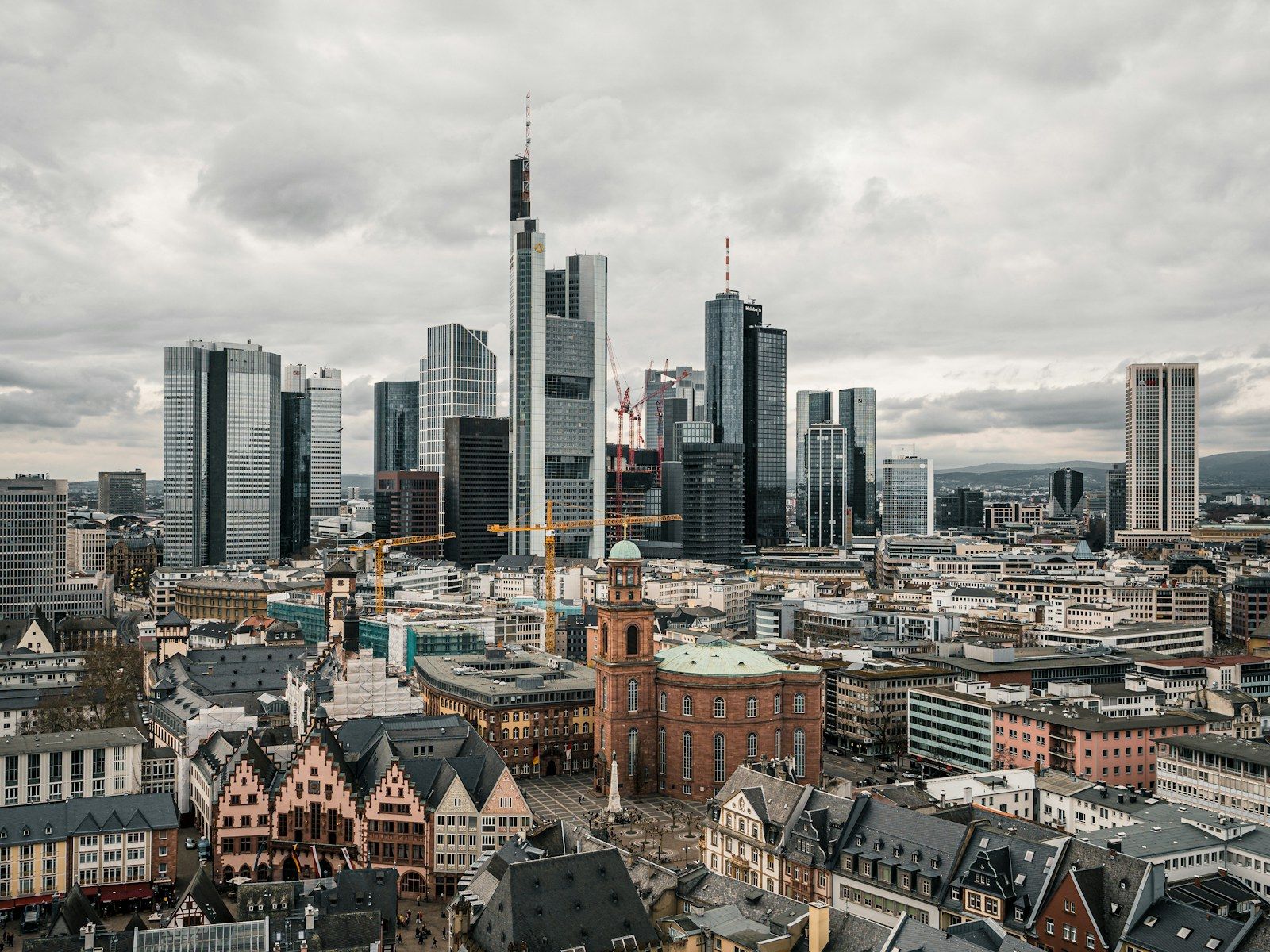
Aerial view of city buildings during daytime by Paul Fiedler Unsplash License
Plan Frankfurt as a film location: skyline, banking district, trade-fair spaces, campuses, private interiors, permits and request checklist.
Frankfurt is attractive for productions because it is immediately readable: skyline, finance, trade fairs, glass offices, the River Main, transport, international business. It is also easy to underestimate. Many of the strongest visuals sit in public space, transport areas, operator-controlled venues or sensitive commercial interiors. That makes the location choice a permit and workflow decision, not just a visual one.
This guide helps you plan a Frankfurt film location realistically: which looks are worth shortlisting, where permissions need early attention, and when a private option through SetScout Frankfurt can be simpler than chasing the iconic public shot.
Frankfurt is not just a generic corporate backdrop. It combines the Main riverfront, high-rises, banks, trade-fair infrastructure, the station district, historic pockets, modern offices, international access and short distances across the Rhine-Main region. That mix works for corporate films, finance communication, recruiting, editorial shoots, commercials, music videos and international B-roll.
The official Film Commission Hesse is a sensible first stop when a production goes beyond purely private spaces. It connects productions with local scouts and contacts and provides information on permits, contracts and production services. The HessenFilm Location Guide is useful for understanding public motifs and official location options across Hesse.
The classic Frankfurt image is often captured from the riverfront, bridges, opposite buildings or rooftop terraces rather than from inside the tower itself. For establishing shots, product films and finance narratives, that can be ideal. But check early whether the camera position, lighting, tripod, drone, vehicle, sound recording or crowd control touches public space. A tiny crew without a lock-off is a very different permit case from a commercial shoot with lights, client monitors and several vehicles.
The banking district reads as Frankfurt immediately, but it is rarely effortless. Outside, security and traffic questions matter. Inside, you need operator approvals, brand and logo checks, privacy review, employee flows, access cards, security staff, reflective glass, night or weekend windows and sometimes strict limits on what can be shown. If you only need the look, a private office with a view, a coworking space, a showroom or a conference floor may be the better production choice.
Trade-fair and event spaces are obvious Frankfurt options, but they need to be assessed differently for production than for events. The questions are not only room capacity. They include loading zones, house power, blocked dates, branding, visitor flows, sound, the fair calendar, security and reset. In larger venues, you need a clear scene description, use case and operator approval before budget or availability can be treated as reliable.
Campus locations can make Frankfurt feel contemporary and less clichéd: seminar rooms, libraries, exterior walkways, labs, cafeterias and corridors. They also bring privacy issues, student or staff movement, semester schedules, house rules and weekend constraints. A campus is not just a backdrop; it is an operating environment.
Frankfurt is not the place for vague public-space plans. Filmhaus Frankfurt states that a filming permit is essential before filming begins and lists the Service Center Events as the central contact for public traffic areas, public squares and pedestrian zones, no-stopping zones, production vehicles, traffic measures and special uses.
Transport locations have their own rules. The VGF allows private photography and filming without written permission in limited cases, but requires its own filming permit for advertising, film production and use beyond purely private purposes; its guidance asks for material such as a script, plot summary or storyboard and notes that review usually takes at least 14 days.
For tourism-focused city marketing, visitfrankfurt also provides a filming-authorisation form that asks for medium, planned location, date, time, duration, content, equipment and crew size. That is a useful model for any serious location request: operators and private hosts need the same operational facts before they can say yes.
Many productions start with the most recognizable shot and end up booking the more controllable one. In Frankfurt, that is often the right decision. A private rooftop with skyline context, an office near the Main, an apartment in Westend or Ostend, a showroom, a hotel suite or a conference floor can deliver the Frankfurt signal while making access, sound, lighting, client handling and reset easier to manage.
A private location does not remove official permit needs if your crew, vehicles, equipment or exterior shots spill onto pavement, roads or operator-controlled areas. It does reduce the production’s dependency on public space. With SetScout film locations, you can test whether the look is available in a bookable space with clear rooms, host communication and a structured request path.
Do not start with twenty attractive images. Start with a decision matrix. Which three motifs actually carry the film? What must read as Frankfurt? Which scene needs clean sync sound? Which space must hold clients and crew? Which option is permit-light enough for the schedule?
Then search deliberately: official bodies for public or city-owned motifs, local scouts for complex city images and SetScout location scouting for private, commercially usable alternatives. That way you are not comparing Frankfurt against a generic room; you are comparing an iconic public image against a controllable production environment.
Frankfurt is strongest when you treat it as more than a skyline. The useful decision comes from three parallel questions: Which image sells the Frankfurt context? Which permits and operator approvals does it trigger? And is there a private alternative that delivers most of the look with less production risk? Answer those before the first request and your location search becomes a production decision, not a sightseeing tour.
More posts you might be interested in
Photo by Joey Banks on Unsplash by Joey Banks Unsplash License
A practical access planning guide for productions and hosts documenting real routes, bathrooms, ramps, holding and limitations before booking.
Photo by Ryan Liu on Unsplash by Ryan Liu Unsplash License
How productions should prepare bar, club and nightclub locations for music videos, fashion, commercials and nightlife content.
Photo by Peter Herrmann on Unsplash by Peter Herrmann Unsplash License
How productions should assess bunker, lost-place and special-motif locations without creating legal or safety risk.
