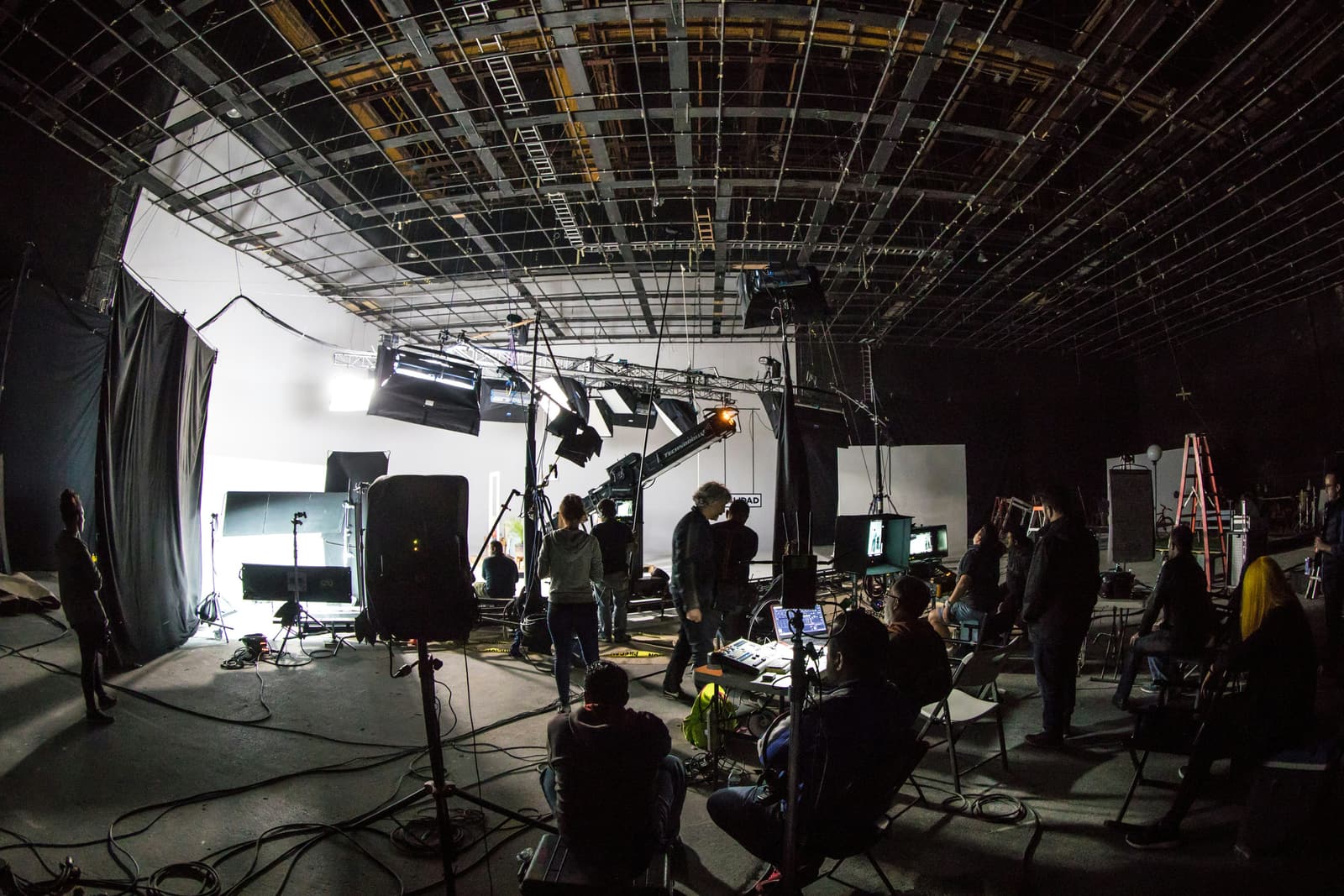
Film set studio photographed with fish eye lens by Brands&People / Unsplash Unsplash License
Film location costs are rarely just a day rate. A useful production budget also accounts for prep, wrap, overtime, cleaning, utilities, security, deposit, insurance and usage rights.
A film location does not only cost the day rate on the first quote. A realistic production budget also includes prep, wrap, overtime, cleaning, power, heating, security, parking, deposit, insurance and the scope of usage rights.
The short answer: small photo or content shoots can work with much lower fees than commercials, TV or film. Across private apartments, houses, villas and commercial spaces, public market signals range from a few hundred euros to several thousand euros per day. The actual price comes from disruption, risk and usage.
This article is a budgeting guide, not a fixed price list and not tax or legal advice. Treat the numbers as market signals, not guaranteed rates.
A location price is the sum of value, disruption and risk. Value means how rare, visually useful, well located and production-ready the property is. Disruption means how much the shoot blocks residents, business operations, staff or guests. Risk means what can be damaged and how hard it is to restore.
That is why a small kitchen can be expensive if it is needed exclusively at night for a commercial with a large crew. A large industrial hall can be cheaper if it is empty, durable, easy to access and already set up for productions.
Public rate data is uneven because many locations quote individually. In an older German market article, LocationRobot described apartment examples starting around EUR 800, well-equipped apartments around EUR 1,200 to EUR 1,500, luxury apartments up to EUR 2,500 or more, and villas around EUR 1,000 to EUR 5,000 per day and above (LocationRobot).
Landauer Locations communicates EUR 1,500 to EUR 5,000 per shoot day for apartments or houses and an additional half-day fee for prep or wrap (Landauer Locations). This is not a universal rate card, but it is a useful signal for private locations in professional productions.
For budgeting, the more important question is what kind of use day is being quoted. A 10-hour photo day, a 12-hour film day, a short content slot, a TV shoot with night work and an exclusive commercial are different products.
The location fee is the amount paid to use the place. Total cost appears only when you add travel, load-in, temporary no-parking zones, parking spaces, cable routes, power, water, heating, cleaning, protection material, staff, security, toilets, catering areas and restoration.
A quote is comparable only when the same services are included. Location A may look cheaper but include no parking, power or cleaning. Location B may look expensive but save crew time, transport and coordination.
The German Federal Association of Location Scouts describes a use day as 12 hours for film, prep and wrap work and 10 hours for photo use; beyond that, an overtime rule per started hour should apply (BVL guide to location agreements).
The same guide describes prep and wrap days as at least half a day rate and notes that hold days, for example over a weekend, can also be compensated (BVL guide). For productions, this means that a one-day shoot can create two or three cost-relevant days.
Not every production uses a location in the same way. A website image film, local social ad, TV spot, international commercial and fiction series create different visibility, duration and brand risk. The broader and longer the usage, the more carefully it should be priced.
Buyout is often used loosely. In practice, it means the production wants to use the captured location material within a defined scope without renegotiating later. For hosts, that can be fair when territory, duration, media, paid media and sensitive industries are transparent and paid for.
Cleaning, power, water, heating, waste, security, concierge, building staff, electrician, protection material, parking and key handling should not remain vague. Either they are included in the day rate or they are agreed as concrete cost items.
The California Film Commission recommends that property owners develop a sliding fee scale based on production budget and crew size, account for prep and strike time, include lost business where relevant, and decide between an all-inclusive rate or a use fee plus reimbursements (California Film Commission). The source is US-specific, but the budgeting logic is useful for production planning.
Suppose an apartment costs EUR 1,500 for a shoot day. Add a half prep day, cleaning, floor protection, two reserved parking spots, overtime risk and a deposit. You are no longer planning for EUR 1,500. You are planning a small cost package.
That does not mean the location is overpriced. It means the quote needs to be honest. For productions, the best negotiation is not the lowest day rate. It is a price that makes all real conditions visible.
SetScout does not replace individual budgeting, but it makes the request clearer. When productions share dates, crew size, rooms, usage, budget and special requirements early, hosts can judge faster whether price and conditions fit.
Compare production readiness, not only photos. Start with suitable film locations, read the clause guide for a film location agreement in Germany and use the German host-side guide to location rental pricing when pricing your own property.
There is no fixed day rate. Public market signals vary by location and production type from a few hundred euros to several thousand euros per day. For a real budget, add time, extras, cleaning, insurance, deposit and usage rights to the base fee.
Not automatically. Some hosts build prep and wrap into the rate, while others charge partial day rates or separate costs. Always ask whether load-in, protection, cleaning and final handback are included.
Buyout usually means a broader usage grant for footage or images of the location. The practical details are media, territory, duration, paid media, stills and sensitive industries. The word alone is not enough; the actual scope belongs in the agreement.
It depends on the provider, their tax status and the invoice. Productions should clarify early whether prices are net or gross and whether VAT will be shown. Tax questions belong with accounting or professional advice, not a rushed location negotiation.
More posts you might be interested in

Industrial interior location by Ümit Yıldırım / Unsplash Unsplash License
Searching film locations by motif works best when each category is briefed with look, era, rooms, logistics, rights and hidden constraints.

Production planning board by Walls.io / Unsplash Unsplash License
Production schedule templates, shot lists and storyboards help location planning only when they expose rooms, access, light, sound, permits and recce risks.

German city skyline by Florian Wehde / Unsplash Unsplash License
A practical comparison of Germany’s production hubs: Berlin, Hamburg, Cologne, Munich and Rhine-Ruhr by look, permits, crew base, transport, seasonality and private-location search.
