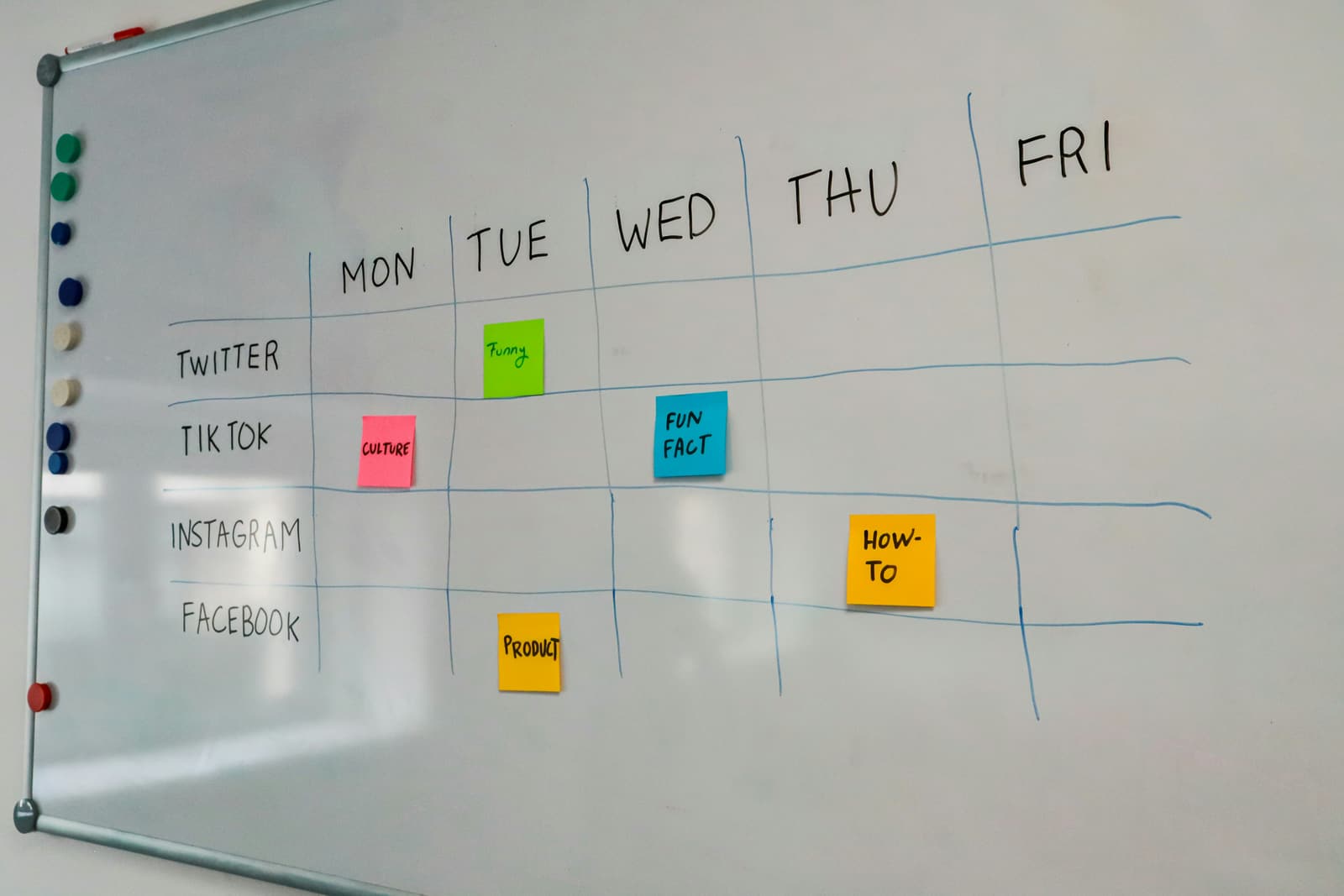
Production planning board by Walls.io / Unsplash Unsplash License
Production schedule templates, shot lists and storyboards help location planning only when they expose rooms, access, light, sound, permits and recce risks.
A production schedule template helps location planning only when it captures more than dates, scenes and call times. For locations, the useful fields are rooms, sightlines, light windows, sound risk, power, access, permits, neighbors and backup options.
The practical sequence is simple: break down the scenes, turn them into location requirements, then check the shot list, storyboard and schedule against each other. That is how a creative idea becomes a searchable location shortlist from the script instead of a vague wish list.
Key Takeaways
A production schedule, shot list and storyboard are not the same document. The schedule orders time and sequence, the shot list turns scenes into camera work, and the storyboard shows how framing, movement and screen direction should feel.
Vimeo describes a shot list as a detailed checklist of shots with practical instructions for the shoot day. Boords separates the visual role of a storyboard from the actionable structure of a shot list. For locations, both points matter because a great-looking room can fail if the practical fields are missing.
On small shoots, one combined spreadsheet can work. The format matters less than the decision quality: can the team see why a location fits, what still needs checking and what can be changed if the day gets tight?
A production schedule template should show which scenes can realistically share one location. StudioBinder’s shooting schedule template notes location dropdowns and page counts. Those fields are useful because they turn a location from a visual choice into a time, access and cost decision.
If scene 12 is in the living room, scene 18 is in the stairwell and scene 23 is on the sidewalk outside the same apartment, the booking request must explain that full package. Otherwise the host may approve the living room while the real risks sit in the stairwell, neighbors and public space.
Add a permit status field early. Private permission is not always the whole answer, especially when sidewalks, streets, parks, parking restrictions or night work are involved. For German productions, use the guide to filming permits in Germany as a starting point.
A standard shot list covers scene, shot, shot size, camera movement and notes. For location planning, that is not enough. You also need the fields that reveal cost, access, risk and whether the scene can be shot at the same place as the rest of the day.
Boords lists scene or shot numbers, camera angles, movement and technical details as core shot-list elements. Movie-College makes a useful practical point from a German film-school context: a table-based shot list can be changed on set and can mark which shots are essential or expendable when location time is limited.
For every shot, add interior or exterior, exact room, camera direction, time of day in the story, required windows, sound sensitivity, power needs, crew size, dressing, props, sensitive surfaces, neighbors, hold areas, parking and plan B. A tabletop insert in a kitchen needs different checks than a wide shot through a window toward the street.
A storyboard is strongest for locations when it exposes spatial dependencies. It does not need polished drawings. It needs to show whether the camera sees through a doorway, whether a window is in frame, whether a hallway needs width and whether two different locations can convincingly play as one place.
Many searches for storyboard templates come from the need to organize the visual idea early. For location work, the key extra question is: which parts of the image are mandatory, and which can be solved through art direction, lighting or camera angle?
Mark hard location requirements directly in the storyboard: visible architecture, ceiling height, natural light source, window view, staircase, elevator, depth for a dolly or gimbal, mirrors, logos and areas that cannot be altered.
A template starts paying off when it becomes a clear location request. Hosts do not need the full shot list, but they do need the risks behind it: dates, times, crew size, rooms, use, technical load, sensitive content, dressing, reset and a responsible contact. The guide on finding a film location from brief to request covers that handoff in more detail.
A common mistake is keeping the internal template detailed, then sending a vague request: We need an apartment for a few scenes. A better version is: two dialogue scenes in the living room, one kitchen insert, a short arrival in the stairwell, 14 crew, sound sensitive, no drilling, same-evening reset.
The recce is where the template meets the real place. Do not only collect good photos. Check the fields that remain open in the schedule: light at the planned time, noise, load-in, breakers, neighbors, dressing, reset and working space. The location recce checklist is the logical next step.
If a storyboard needs deep space, do not only ask for square meters. Check whether the camera can actually move back, whether furniture can be moved and whether crew can work outside frame.
SetScout fits between the location brief and the request. You can turn a script, shot list or storyboard into concrete search criteria: daylight altbau kitchen, quiet courtyard, glass office, drive-in warehouse, house with a wide staircase. For less obvious motifs, AI film location search can help generate options, as long as the team still checks the result with production judgment.
The point is not to copy every template field into a marketplace. The point is to turn planning documents into better search terms and better requests. The clearer the location fields are, the faster you can tell which place only photographs well and which one can carry the shoot day.
Build the location shortlist from the shot list: search by motif, light, room, access and constraints before you send the booking request.
For the first search, the shot list is usually the most useful because it connects the image, room and technical need. The production schedule becomes more important when several scenes must share one location. The storyboard helps when space, sightlines or camera movement decide the location.
Yes, at least as a status field. Separate private owner permission, building management, public space, parking, closures, night work and special use. That makes it clear which locations fit creatively but may be risky for timing or operations.
No. Interviews, social clips and simple product shoots can often work with a shot list and reference images. A storyboard is worth the time when movement, perspective, continuity, dressing or visual effects strongly shape the space.
Start with scene ID, location type, room, interior or exterior, story time, must-have visual requirement, sound sensitivity, power need, crew size, permit status and priority. Those fields are enough to turn a loose location idea into a request someone can evaluate.
More posts you might be interested in

Industrial interior location by Ümit Yıldırım / Unsplash Unsplash License
Searching film locations by motif works best when each category is briefed with look, era, rooms, logistics, rights and hidden constraints.
German city skyline by Florian Wehde / Unsplash Unsplash License
A practical comparison of Germany’s production hubs: Berlin, Hamburg, Cologne, Munich and Rhine-Ruhr by look, permits, crew base, transport, seasonality and private-location search.
Film crew in a city street by Robert Andall / Unsplash Unsplash License
A practical starting directory for filming permits in Germany: Berlin, Hamburg, Munich, Cologne, NRW, Frankfurt, Stuttgart and Leipzig with official links and request checklist.
