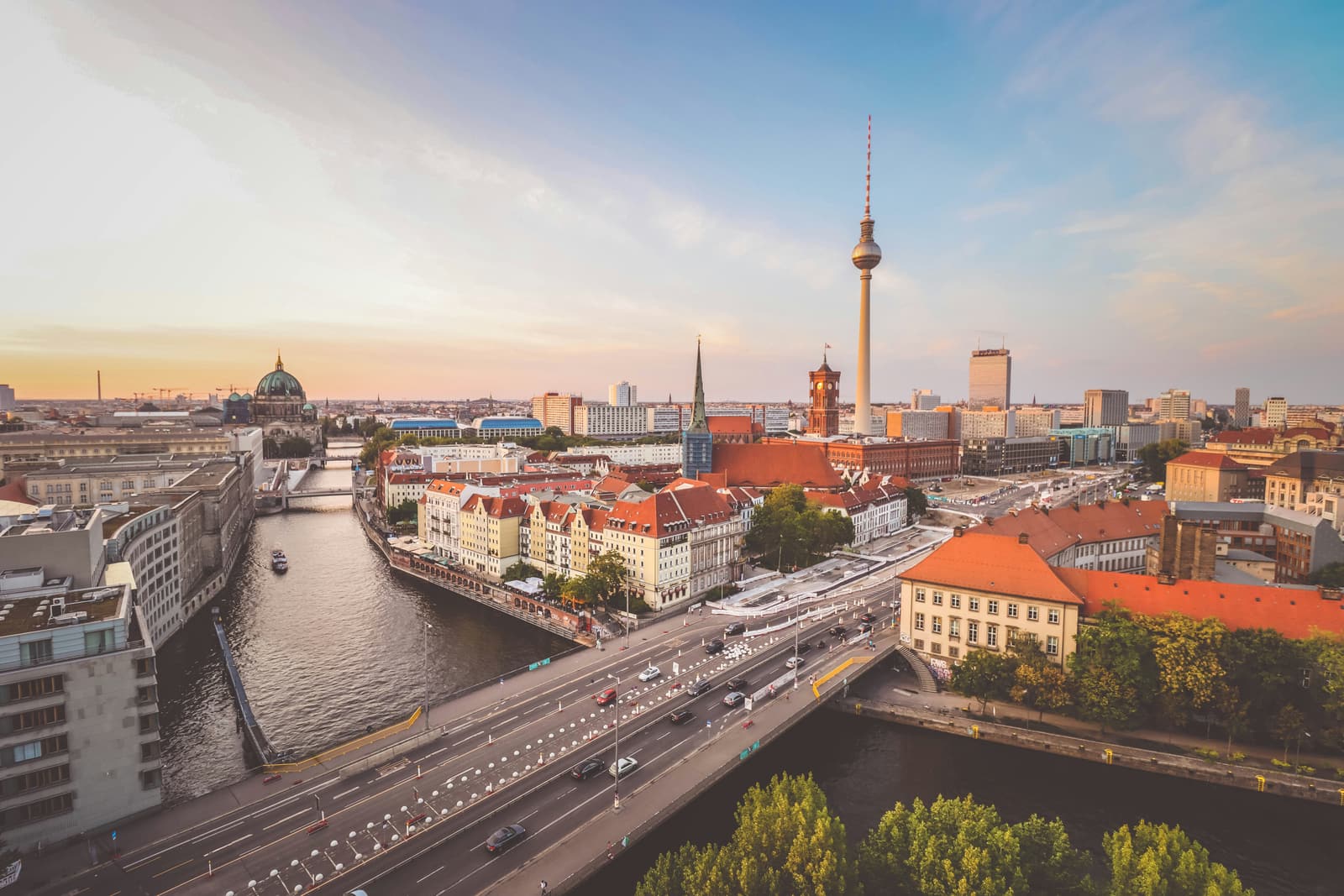
German city skyline by Florian Wehde / Unsplash Unsplash License
A practical comparison of Germany’s production hubs: Berlin, Hamburg, Cologne, Munich and Rhine-Ruhr by look, permits, crew base, transport, seasonality and private-location search.
Film production in Germany is not one market. Berlin, Hamburg, Cologne, Munich and Rhine-Ruhr offer very different looks, crew bases, permit routes, traffic patterns and production logic.
For international and national productions, the right city is a practical choice: which look is believable, which permit path is manageable, how quickly can you find private locations and where do logistics costs appear?
This guide compares Germany’s main production hubs from a location perspective. It does not replace local permit advice, but it helps with the first shortlist decision.
Do not compare cities only by famous landmarks. For a shoot, five criteria matter: believable look, permit path, crew and service base, transport and availability of private alternatives.
A location may look better in Berlin but be easier to coordinate in Cologne. A Hamburg harbor look may be unique but need more lead time because of wind, water and public ground. A Munich premium look may be strong but tighter on price and availability.
Berlin is strong when a project needs urban variety: founder apartments, clubs, Plattenbau, period buildings, government, tech offices, art, industry, courtyards, lakes, forests and Brandenburg within reach.
The Berlin Brandenburg Film Commission offers location and permit information, location search, a Production Guide and authority search. Medienboard describes the BBFC as the first stop for teams working in the capital region.
The advantage is choice. The downside is complexity: districts, public roads, parks, BVG, Deutsche Bahn, heritage rules, police and private owners can all matter at once. Plan Berlin with a clear map of surfaces.
Hamburg works well for harbor images, water, Speicherstadt and brick looks, media and agency settings, upscale residential areas, bridges, wind, docks, offices and northern travel images.
MOIN Filmförderung describes its Film Commission as the first point of contact for locations, permits and local production infrastructure in Hamburg and Schleswig-Holstein. The regional advantage is proximity between city, sea, countryside and coast.
In Hamburg, pay close attention to harbor areas, water, wind, bridges, parking, permit paths, weather changes and transit or rail spaces. The look is strong, but exterior work needs careful prep.
Cologne is a natural fit for TV, commercials, comedy, corporate, creator formats, Rhine motifs, urban neighborhoods, studios, agencies and everyday western German settings.
The City of Cologne runs its own filming-permit page and names at least ten working days before the shoot for applications on city areas. For production teams, that is a clear deadline anchor.
Cologne’s advantage is proximity to many other NRW cities. If a location does not fit in Cologne, Düsseldorf, Bonn, Essen, Wuppertal, Duisburg or smaller Rhine-Ruhr towns are quickly in range.
Rhine-Ruhr is strong when you need industry, logistics, office parks, city spaces, former industrial sites, neighborhoods, event halls, clinics, universities or several looks within short driving distance.
Film Commission NRW explains that there is no general NRW-wide permit process. The respective cities and specialist offices remain responsible. That matches the region: lots of choice, but local coordination for each location.
Do not plan Rhine-Ruhr as one city. Decide early which city is the base, which locations are truly in range and whether cross-city traffic will eat into shooting time.
Munich is strong for premium city images, classic architecture, automotive, agency and corporate worlds, villas, hotels, museums, Bavarian motifs, lakes and Alpine access.
Film Commission Bayern points to a Production Guide for service providers, production companies and crew in Bavaria. That helps when a project needs local services as well as locations.
Munich can feel more expensive and schedule-constrained than other hubs. Check private alternatives, parking, municipal areas, lakes, mountains, tourism periods and weather windows early.
Germany is highly seasonal. Berlin in winter, Hamburg in wind, Cologne around carnival, Munich during trade fairs or Oktoberfest periods and Rhine-Ruhr during major events can behave very differently from the moodboard.
Check not only climate but the city calendar: trade fairs, sport, holidays, closures, large events, tourism, exams, political dates and local events. They affect hotels, parking, noise, authority workload and location availability.
A cheaper permit does not automatically make a cheaper shoot. Crew travel, hotel prices, parking, load-in, overtime, location fee, equipment transport, traffic measures, security and backup plans matter more.
A private location outside the city center can look expensive and still save money if it includes parking, holding, power, toilets and quiet support space.
Private locations are strongest when you need control: interiors, real apartments, offices, restaurants, courtyards, roof terraces, gardens, villas, workshops, warehouses, small exterior areas or locations with holding and technical space.
They do not automatically replace public permits, but they can reduce the public footprint. Less sidewalk, less parking pressure, less open street and more predictable support space are often the real advantage.
SetScout helps connect the city decision to real private locations. Use /drehorte to compare suitable spaces by hub instead of choosing between Berlin, Hamburg, Cologne, Munich or Rhine-Ruhr in the abstract.
A strong shortlist quickly shows whether a city can actually deliver: suitable locations, realistic availability, clear logistics and less public-permit risk.
There is no best city for every shoot. Berlin offers variety, Hamburg water and harbor, Cologne and Rhine-Ruhr TV and industrial motifs, Munich premium city looks and Alpine access. The best hub depends on location and workflow.
Practically, yes; administratively, no. The proximity of many cities is a benefit, but permits, authorities, traffic and location owners remain local. Plan Rhine-Ruhr as a city network.
When you need control, sound, power, support space, parking, privacy or fast availability. Private locations can reduce public permits, but they do not always replace them.
Berlin, Munich, Hamburg and NRW can all support international work. The deciding factors are language, crew needs, motif type, travel routes, funding logic, permits and local production partners.
More posts you might be interested in
Industrial interior location by Ümit Yıldırım / Unsplash Unsplash License
Searching film locations by motif works best when each category is briefed with look, era, rooms, logistics, rights and hidden constraints.

Production planning board by Walls.io / Unsplash Unsplash License
Production schedule templates, shot lists and storyboards help location planning only when they expose rooms, access, light, sound, permits and recce risks.
Film crew in a city street by Robert Andall / Unsplash Unsplash License
A practical starting directory for filming permits in Germany: Berlin, Hamburg, Munich, Cologne, NRW, Frankfurt, Stuttgart and Leipzig with official links and request checklist.
