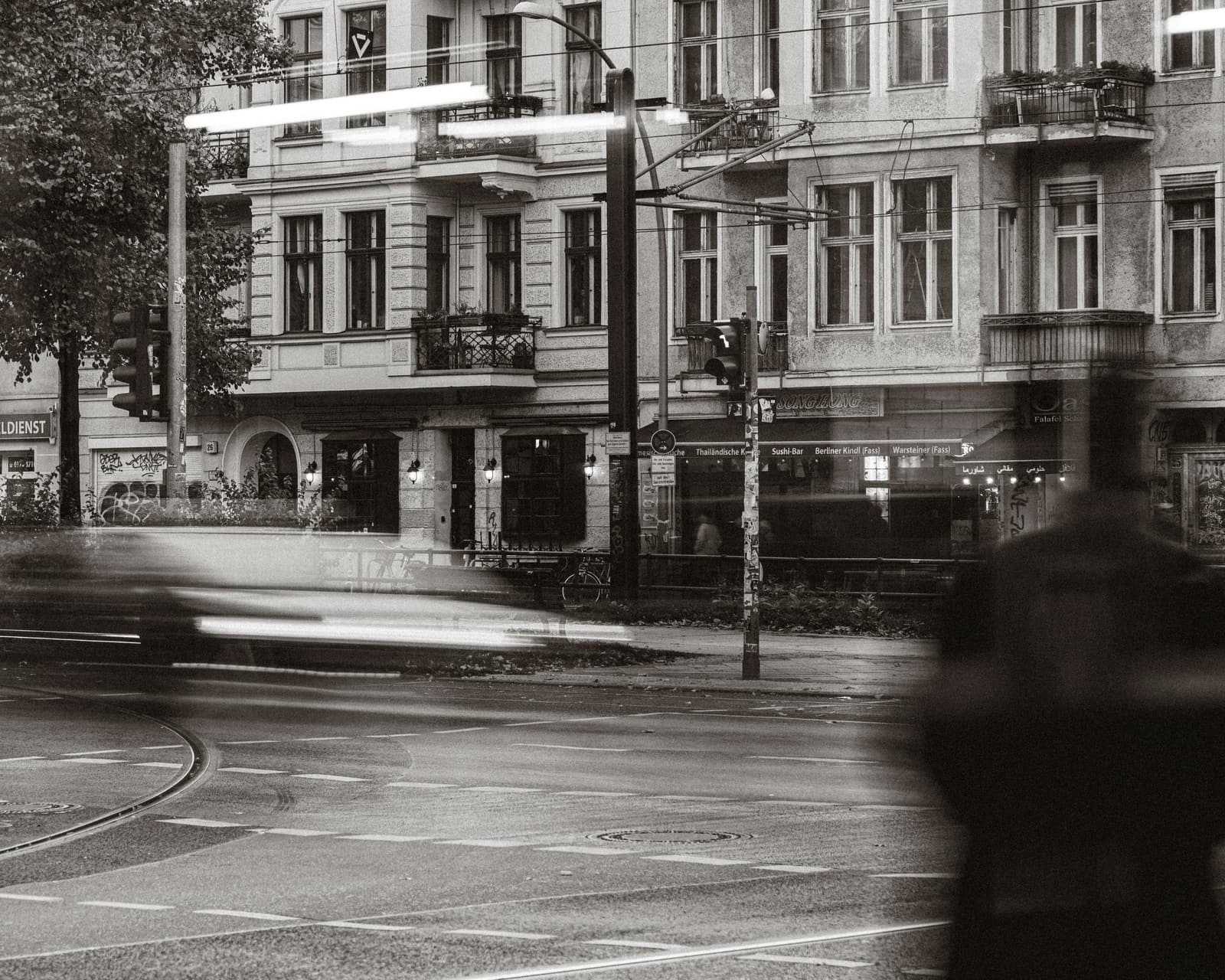
Berlin street with buildings by Joacim Bohlander / Unsplash Unsplash License
When a location scout in Berlin is worth it, when a platform is enough for the first shortlist, and how to judge budget, timeline, permits, recce needs and negotiation work.
A location scout in Berlin is worth it when the brief is hard to translate into real places, when several owners or authorities may be involved, when many options must be checked on site, or when negotiation needs active handling. For the first shortlist, a platform is often enough if the look, budget, timing and production limits are clear.
The practical answer is rarely scout or platform. The better workflow is usually sequential: narrow the field digitally, then use human scouting where local access, permit judgment, recce prep and owner coordination create real value.
A location scout translates a creative brief into real places, checks whether those places can actually carry the shoot, and prepares a decision for direction, camera, production design and production management. The Berlin Brandenburg Film Commission describes a typical scouting path: search location databases, clarify basic facts with the provider, arrange an in-person visit, take photos and notes, present the results to the core team and prepare a recce if the location remains viable.
The value is not just discovery. A good scout removes false positives, catches practical risks, asks the questions a listing cannot answer, and saves the production from visiting places that were never likely to work.
A platform is enough for the first stage when you need visual options, budget signals and early pass-or-fail criteria. That is especially true for apartments, houses, studios, commercial spaces, lofts, restaurants and offices where photos, floor area, location and basic rules already answer many questions.
For a smaller commercial, interview, social shoot, editorial or photo production, a digital shortlist can do a large share of the early research. The key is to rank locations by shootability, not only by image: access, floor level, lift, parking, light, noise, neighbors, power, bathrooms, off-limits areas and reset work.
SetScout fits this stage as a search and comparison layer. You can narrow Berlin options faster, build a first team shortlist, and then request or inspect only the locations that have a realistic chance of working.
A scout becomes valuable when the brief cannot be solved cleanly through existing listings. Common triggers include several city looks in one schedule, sensitive ownership structures, very short lead time, public-space use, night shoots, children, animals, weapon props, stunt work, substantial lighting, large vehicles or a motif that sounds simple but is hard to access in Berlin.
High creative specificity is another signal. “Old Berlin apartment with patina” is searchable. “An apartment that feels like early-1990s West Berlin, has not been renovated into neutrality, has a believable courtyard stairwell and can still hold a 25-person commercial crew” needs local interpretation.
At that point, the scout is not a more expensive search box. The scout is the person connecting reality, aesthetics and production risk.
Berlin permit questions should not wait until after the final location choice. The BBFC notes that filming in Berlin and Brandenburg beyond ordinary public use generally requires a permit, except for current reporting. Public streets and grounds can involve special use, traffic-law orders and supporting documents depending on the measure.
Service Berlin also states that placing technical vehicles, catering, make-up or similar production support on public road land in connection with filming on private property can count as special use. A private interior is not automatically simple if the production depends on the street outside.
The BBFC recommends submitting certain Berlin public-road applications as early as possible, at least two weeks and ideally three weeks or more before the measure starts. It also lists general filming permit fees of 50 euros for one day, 120 euros for three months, 200 euros for six months and 300 euros for one year. That does not replace a project-specific authority check, but it shows why timing belongs in the location decision.
Private locations require approval from whoever has the right to grant it. The BBFC names owners, public bodies, districts, municipalities and other responsible entities as possible points of approval. For rented spaces or properties with owners' associations, extra consent may be needed.
That does not automatically mean you need a scout. If a platform already provides owner contact, location details and clear ground rules, the production can often make the first request directly. A scout matters more when it is unclear who can approve the shoot, when several parties must agree, or when the location has sensitive areas.
The budget question is not only: what does a scout cost? It is: what does a bad shortlist cost? If direction, camera and production lose half a day visiting unsuitable locations, the cheap research path can become expensive quickly.
For smaller budgets, a staged workflow is often best: platform research, hard exclusion questions in the first request, then only a small number of physical visits. For larger budgets, multi-day schedules or tight shoot plans, a scout can be useful before the first request because the cost of mistakes is higher.
With six weeks of lead time, a platform can provide breadth and the production can follow up methodically. With only a few days, local knowledge matters more: who responds quickly, which districts are difficult, which places look good online but fail on access, parking or neighbors?
A platform still helps under time pressure. It reduces the starting set. A scout can then work from a better base instead of beginning from zero.
Use this matrix as a quick production decision. If several points in the second line apply, plan for scout time or location-management support.
For Berlin locations: /en/film-locations-berlin. For Berlin scouting workflow: /en/location-scouting/berlin. For AI-assisted search by text, image or scene: /en/ai-film-location-search.
No. Small productions with a clear brief, a private interior and flexible timing can often start through a platform. A scout becomes useful when the location is hard to find, several approvals are needed, or public space, neighbors and logistics strongly affect the shoot.
It is an important official research source, but it does not automatically replace scout work. Databases help with the first search. A scout then evaluates suitability, access, permit risk, recce needs and negotiation effort against the actual production brief.
SetScout is enough for the first shortlist when you want to compare real locations, protect against having only one option, and see which places might match the brief. Before booking, still verify availability, approval, contract terms, support spaces, technical needs and possible permits.
When the schedule depends heavily on the location. That includes multiple motifs, very short deadlines, public streets, difficult ownership structures, sensitive facilities or a look that cannot be judged reliably from online material alone.
Build a Berlin shortlist with realistic candidates first. If two or three options look right but depend on permits, access, schedule or negotiation, that is the point where scout work earns its place.
More posts you might be interested in

Industrial interior location by Ümit Yıldırım / Unsplash Unsplash License
Searching film locations by motif works best when each category is briefed with look, era, rooms, logistics, rights and hidden constraints.
Production planning board by Walls.io / Unsplash Unsplash License
Production schedule templates, shot lists and storyboards help location planning only when they expose rooms, access, light, sound, permits and recce risks.

German city skyline by Florian Wehde / Unsplash Unsplash License
A practical comparison of Germany’s production hubs: Berlin, Hamburg, Cologne, Munich and Rhine-Ruhr by look, permits, crew base, transport, seasonality and private-location search.
