
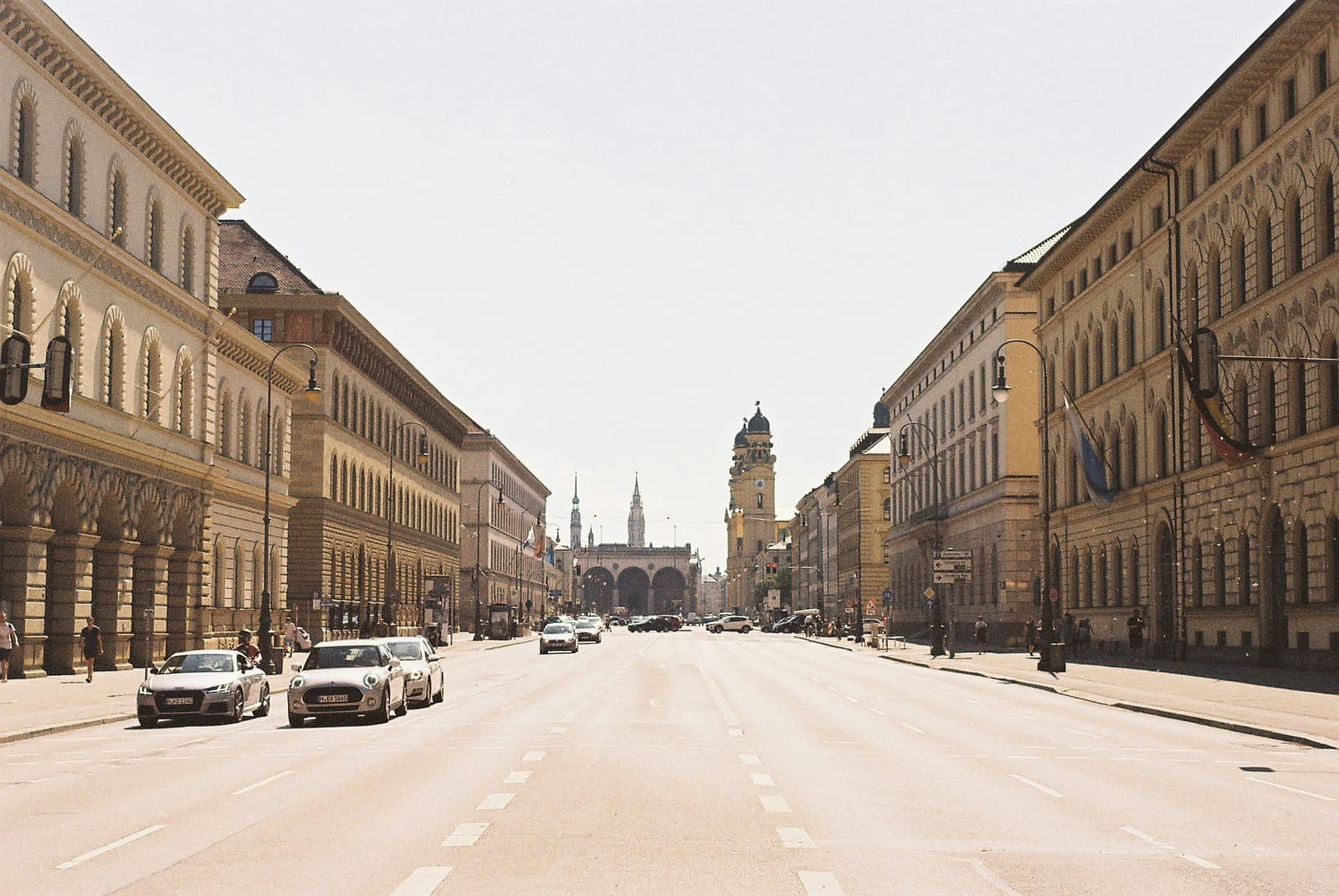
cars parked on side of the road near brown concrete building during daytime by nika tchokhonelidze / Unsplash Unsplash License
Munich and Bavaria filming permits 2026: city, state, palaces and private locations
What productions should clarify before scouting in Munich and Bavaria: who approves permits, the low-effort exemption, lead times, state palaces and when a private location is simpler.
Munich and Bavaria do not have one filming permit. They have several responsible authorities. For a shoot in Munich, what matters most is where your crew stands, who manages the area and whether the effort goes beyond a small handheld camera.
This guide is not legal advice and does not replace guidance from the authorities. It helps producers, production managers and agency teams find the right route before scouting, instead of calling the wrong office during the shoot week.
Quick takeaways for productions
- Munich manages its own public roads. The responsible body is now the film service office in the Mobilitätsreferat, no longer the previously cited Kreisverwaltungsreferat.
- Small shoots with low effort, no more than five people and no extra equipment do not need a filming permit in Munich. Anything beyond that does.
- State palaces, gardens and lakes go through the Bavarian Palace Administration, which charges a fee and needs at least ten working days.
- Outside Munich, the local municipality or district office is the first contact. The Film Commission Bayern does not issue permits, it mediates.
Which filming permit do you need in Munich and Bavaria?
The short answer: it depends on who manages the area. In Munich, public traffic areas belong to the city, specifically the film service office in the Mobilitätsreferat (City of Munich: filming permits). State-owned sites, other municipalities and private spaces each have their own routes.
For planning, the legal category matters less than what your crew actually uses. A room can be private while the lighting stands sit on the pavement. A palace can be the perfect site while the interior shot is paid and tied to a lead time.
Munich manages its own public space
As soon as you use public traffic areas in Munich for filming, you need a permit from the film service office in the Mobilitätsreferat. The city states a lead time of at least ten working days for a complete application before the desired date, and more time for closures (City of Munich: public traffic areas).
The city calculates the total fees only after filming ends. So treat the permit not as a final formality, but as a fixed scheduling and cost factor in the budget.
Low effort: when Munich does not require a permit
For low-effort recordings, Munich does not require a filming permit. The city sets clear conditions: only handheld cameras or at most one camera on a tripod, no extra equipment such as drones, generators or lighting rigs, no more than five people on set, and no scenes that affect public safety or order (City of Munich).
As soon as you cross one of these limits, the case becomes subject to approval. A second tripod, a generator, a sixth person on the team or a barrier is enough.
Street special use instead of a filming permit
There is a special case that is often missed. If the shoot takes place inside a building, but auxiliary equipment such as spotlights or trailers is set up on the pavement or street, the city says you do not need a filming permit, but a street special-use permit (City of Munich).
This affects many private locations. The interior is booked, but the lighting setup, cable runs or a unit trailer sit in public space. That is exactly where an extra application appears and costs time.
Green spaces and special sites have their own contacts
For municipal green spaces, Munich uses a separate route through the film service office, with advance notice to the parks supervision unit. Conditions are similar to public traffic areas, plus a ban on vehicles inside the grounds (City of Munich: filming permits).
Other sites have their own fixed contacts: the Viktualienmarkt and market halls, the Theresienwiese, schools, cemeteries, protected nature areas and areas owned by the transit operator MVG and Deutsche Bahn. Clarify early which authority your target site belongs to.
Palaces, gardens and lakes: the Bavarian Palace Administration
Many of Bavaria's most recognizable sites belong to the state. Filming in the monuments, gardens and lakes managed by the Bavarian Palace Administration needs prior written permission and takes place against an appropriate usage fee (Bavarian Palace Administration: filming permit).
Beyond the fee, expect cost reimbursement: staff costs for supervision, conservation support where needed, plus electricity and cleaning. The amount depends on the prominence of the site, the technical and personnel effort and the intended use. Here too, plan at least ten working days, with requests to [email protected] (Bavarian Palace Administration).
Shooting outside Munich: municipality, district office and film commission
Bavaria has no statewide filming permit. Outside Munich, the local municipality or district office is the first contact for public areas. State roads, nature reserves or bodies of water can bring additional authorities into the process.
The Film Commission Bayern does not issue permits itself. It is a first point of contact, mediates between production and licensing authorities and runs the location database filmlocations-bayern.de (Film Commission Bayern). For complex permits, it is a sensible first contact.
Private locations: often the simpler route
On private land, the owner is the central permission giver. You need consent and a proper location agreement, but no municipal permit route, as long as the shoot stays on the property.
That is exactly why a private, production-ready location is often faster than a public landmark. But as soon as pavement, no-parking zones, loading zones, drones or exterior shots are involved, the municipal rules apply again. Check the boundary between private area and public space early.
What information belongs in the request?
A good request reads like a precise production brief. The more concrete you are, the faster the city, district office, palace administration or location owner can assess the case. Vague details lead to questions, not flexibility.
- Production type, title, client and responsible on-site contact
- Location address, exact areas, site plan and zones for setup, action, catering and technical equipment
- Date, backup date, setup, filming, strike and planned hours
- Crew size, vehicles, no-parking zones, closures, lighting, sound, power, generators and expected noise
- Insurance proof, owner approval, location agreement and sensitive content, where relevant
The practical workflow before scouting
Do not start with the form. Start with the location risk. Work from the inside outward: room, building, property, pavement, street, green space, state monument.
- Define the scene: interior or exterior, day or night, crew size, vehicles, equipment, sound and lighting.
- Mark every area used: rooms, courtyard, entrance, pavement, street, parking areas, loading zone and catering.
- Identify the responsible party: owner, city film service, parks unit, palace administration, municipality or district office.
- Request the location only with complete basics so price, availability and permit risk can be assessed together.
How SetScout helps with preparation
SetScout does not replace the authorities. It helps you collect the right location data early: rooms, use, crew size, access, parking and availability. Start with shooting locations in Munich, compare shooting locations in Bavaria or plan the search through location scouting in Munich.
FAQ about filming permits in Munich and Bavaria
Do I need a filming permit for a small shoot in Munich?
Not necessarily. Munich waives the filming permit for low-effort shoots if you use only handheld cameras or one camera on a tripod, no extra equipment, no more than five people, and do not affect public safety. Any exceedance makes the shoot subject to approval.
How long does a Munich filming permit take?
The city states at least ten working days for a complete application before the desired date. For closures, plan more lead time. Total fees are calculated only after filming (City of Munich).
Who is responsible outside Munich?
For public areas outside Munich, the local municipality or district office is the first contact. The Film Commission Bayern does not issue permits, but helps with mediation and with complex applications.
What does filming in a Bavarian palace cost?
The Bavarian Palace Administration issues paid permits. Beyond the usage fee, cost reimbursement applies, for example for supervision, electricity and cleaning. The amount depends on the prominence of the site, the effort and the intended use (Bavarian Palace Administration).
Matching film locations
Find bookable locations for the topic of this article here:
Filming permits compared by city
Responsible offices, fees, lead times and online applications for 30 German cities, each with an official source.
See the 2026 city comparisonRecommended articles
More posts you might be interested in

none by Jakub Zerdzicki All photos and videos on Pexels can be downloaded and used for free.
Tax rules for income from renting out a film location
How to report profits from renting out your location correctly for German tax purposes
Inventorying film equipment before a location shoot by OpenAI image generation for SetScout Original image generated for SetScout; no third-party source image used
Film Equipment Insurance: Documenting Owned and Rented Gear
A practical checklist for cameras, lighting, sound and rented film equipment: confirm inventory, values, transport, storage and claims procedures before the shoot.
Film insurance for a production at a prepared location by OpenAI image generation for SetScout Original image generated for SetScout; no third-party source image used
Film Insurance for Productions: Coverage, Costs and Location Risks
Which insurance modules a film production should review, which details affect the premium and how to include locations properly in the risk assessment.