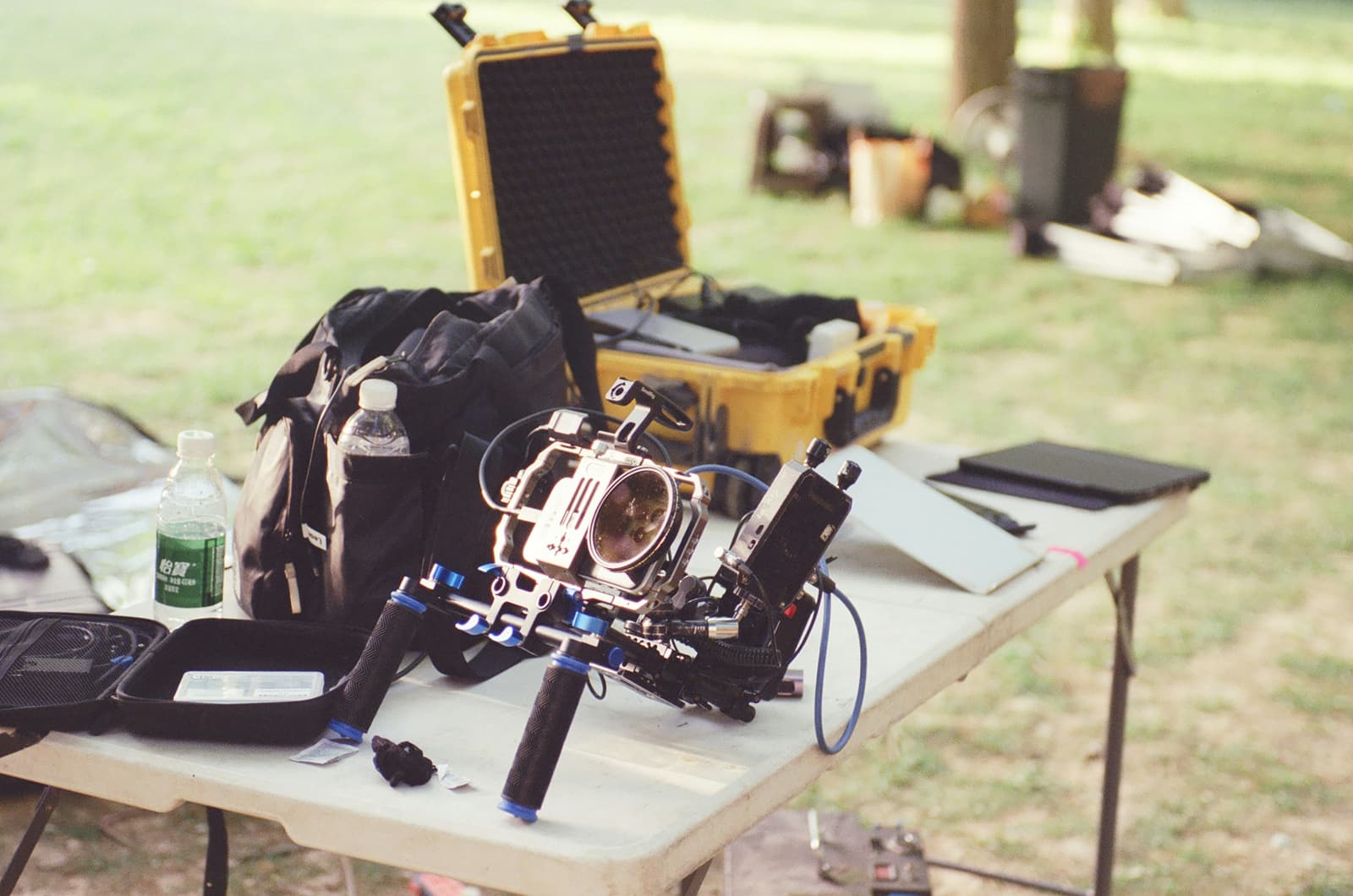
Film equipment on location by Austin / Unsplash Unsplash License
A production-ready listing answers the key questions before the recce: look, dimensions, photos, access, power, sound, rules, price and availability.
A production-ready location is not just a beautiful room. It is a film location with enough information for a production to judge time, risk and budget before the recce.
A good listing therefore does not only answer what the place looks like. It answers: how big it is, how the crew gets in, where lights can stand, how noisy it is, what is allowed, what it costs, when it is available and who can approve it.
Production-ready means a listing contains enough reliable information for location management, production, director, camera, sound and art department to make a first decision. It does not mean the shoot is automatically permitted or every question is solved without a site visit.
LocoScout describes location databases as tools for pre-screening, not replacements for site visits. That boundary matters: a strong listing reduces wasted scouting, but it does not replace final checks on location.
Production readiness is therefore a quality standard for the inquiry phase. The better the data, the less a host has to explain on the phone and the faster a production can see whether a location fits.
A good scorecard separates must-have data from bonus data. Must-have data makes a listing understandable. Bonus data makes it easier to decide on, share internally and take into a recce.
On SetScout, important publish and readiness points include title, short description, longer description, address with map and timezone, area, rooms, daily price, enough approved images, category, tags, facilities and availability.
For production teams, that is the base. A listing gets stronger when it also explains areas, ceiling height, floor plan, accessibility, safety notes, power details, parking, house rules and seasonal limits.
The title should say what the location is, not only how it feels. "Bright Berlin Altbau apartment with bay window" is more useful than "dream space". Productions search for motifs, rooms and visual logic.
The short description answers in a few sentences: what the look is, which rooms can be used, what production size is realistic and which limit matters early.
Photos are the strongest pre-filter. The California Film Commission asks location submissions to show as much visual information as possible about interior and exterior look. For production listings, that means wide shots, reverse angles, windows, ceiling, floor, exterior and logistics images.
On SetScout, a listing becomes much more useful when it has several approved images and a clear cover. Better still are image sets for each area: main room, support room, access, exterior, parking and details that show rules or limits.
Avoid images that only sell. Show the staircase, elevator, loading zone, fuse box, corridor and bathroom too. Those are often the first practical questions.
Productions need area, room count, ceiling height and usable zones. A large apartment can fail as a location if every room is narrow. A small hall can work well if the door, height and yard fit the shoot.
Break larger locations into areas: kitchen, living room, shop floor, restaurant room, yard, office wing, warehouse, roof, garden, studio floor. For each area, name, size, height, photos and restrictions help.
Access is more than the address. Productions need to know whether vans can stop, whether stairs or elevators are available, how gear is carried, whether loading windows exist and who opens doors.
For commercial spaces, loading zones, roller doors, freight elevators, yard use and neighboring businesses belong in the description. For apartments, stairwell, neighbors, building management, doorbell, parking and quiet setup times matter.
A film location listing should not treat facilities as a vague list. Power type, household power or three-phase power, fuse box, water, heating, Wi-Fi, bathrooms, kitchen, holding space and parking are real production data.
If something is missing, that is not always a dealbreaker. It just needs to be visible early. A team can plan a generator, mobile toilet, catering or hotspot if it does not learn about the gap on shoot day.
Sound is a common reason beautiful locations fail. Tram, construction, school, restaurant, ventilation, neighbors, dogs, elevator, courtyard or refrigerator noise can affect interviews, dialogue or advertising.
Describe normal noise windows and sensitive neighbors honestly. A production can then judge whether the location fits photo, social content, music video, interview or narrative work.
House rules are not a later formality. They decide whether an inquiry fits at all: shoes, moving furniture, drilling, haze, animals, food, night work, sensitive rooms, exterior areas, neighbors, brand surfaces and reset.
For hosts, clear limits are not a disadvantage. They filter poor-fit inquiries. For productions, clear rules are better than surprises after approval.
A production-ready listing needs a sensible daily price and clear availability. On the host side, SetScout uses one daily price as the base; the specific inquiry, scope, date and special requirements are clarified in the booking process.
Useful extra details include minimum booking, blackout dates, lead time, quiet hours, possible night work and whether prep or wrap needs separate planning.
A listing is only as production-ready as the person behind it. Productions need to know who answers, who can decide on site, whether owner approval exists and when an inquiry can realistically be confirmed.
For hotels, offices, factories, restaurants and residential buildings, this role matters. If someone can introduce the location but cannot approve use, say that early.
Use this simple weighting when reviewing a listing internally. It is not the official SetScout score. It is an editorial benchmark for production usefulness.
SetScout checks several readiness points while hosts build listings before publication makes sense: basics, description, media, category, facilities, price and availability. Extra depth such as area images, floor plans, safety notes and accessibility details improves usefulness.
For hosts, the best next step is to close missing required fields, then add the questions productions always ask. For productions, use the data for preselection, but confirm critical points before contract or shoot approval.
Not automatically. Publication means the base is in place. Production-ready is a higher bar: the data should help a production judge feasibility, risk, cost and next steps realistically.
The most common mistake is too much look and too little logistics. Strong photos matter, but without access, power, parking, rules, price and availability, the location is hard to request.
No, but floor plans help a lot for larger or more complex locations. If no floor plan exists, dimensions, room sequence, routes and area photos should be especially clear.
Restrictions filter poor-fit inquiries. If haze, night work, animals, moving furniture or certain rooms are not allowed, productions learn that early and can plan correctly or choose another location.
More posts you might be interested in

Industrial interior location by Ümit Yıldırım / Unsplash Unsplash License
Searching film locations by motif works best when each category is briefed with look, era, rooms, logistics, rights and hidden constraints.
Production planning board by Walls.io / Unsplash Unsplash License
Production schedule templates, shot lists and storyboards help location planning only when they expose rooms, access, light, sound, permits and recce risks.

German city skyline by Florian Wehde / Unsplash Unsplash License
A practical comparison of Germany’s production hubs: Berlin, Hamburg, Cologne, Munich and Rhine-Ruhr by look, permits, crew base, transport, seasonality and private-location search.
