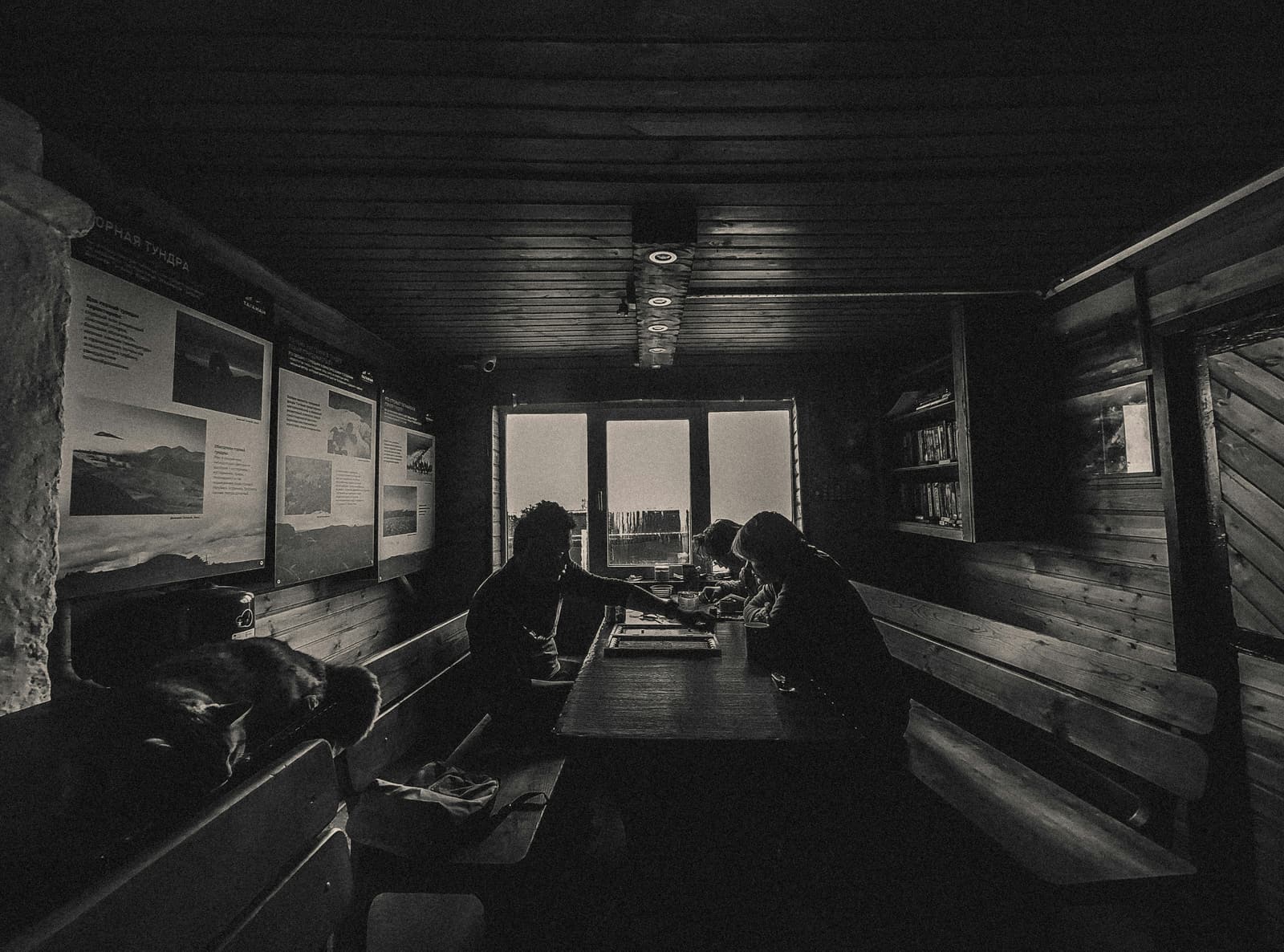
People sitting at a table in a rustic cabin. by Hanna Lazar / Unsplash Unsplash License
A fair location fee is not a square-meter calculation. It depends on production type, disruption, exclusivity, rooms, timing, crew size, usage rights, extras, insurance and the host's minimum price.
Calculating a location fee is not a square-meter formula. A fair film location price comes from the value of the property, the disruption for the host, the usefulness for the production and the risks before and after the shoot.
For hosts, the right question is: at what price is this disruption worth it? For productions, the question is: what price makes the location reliably usable without hidden costs after approval?
This article is a pricing framework, not a fixed rate card and not tax or legal advice. Use it to build a clear pricing logic and then compare real quotes.
LocationRobot describes the core problem in the German market: there are no fixed rules or nationwide agreements because every location and production is different (LocationRobot). That is why the location fee should come from several pricing factors, not one isolated number.
A villa, rented apartment, restaurant, office and warehouse are not priced by the same logic. More importantly, a five-person social ad is not the same as a 35-person commercial with a lighting truck and international usage.
The minimum price is the amount at which the host would actually release the location for a production day. It does not define the market price. It defines the host's own effort: preparation, presence, lost use, uncertainty, reset and the stress of letting a crew into sensitive rooms.
The California Film Commission recommends that property owners build a sliding fee scale by production budget and crew size, and account separately for prep and strike time (California Film Commission). Applied to Germany, that means the minimum price is the floor, not automatically the final quote.
Photo, social content, music video, TV, series, advertising and feature film have different budgets and different risks for the property. A small editorial photo shoot may pay less than a branded film, even when both use the same room.
For hosts, this is not a reason to ask for unrealistic fees. Productions compare several options. A price that does not match the production value often leads not to a better negotiation, but to another location.
The more areas are blocked, the higher the fee should be. A living room for four hours is different from a full house, garden, garage, staircase, kitchen, bathroom, holding area, makeup area, catering space and parking for a full shoot day.
For commercial spaces, disruption is even more concrete: lost revenue, staff access, customer data, stock, opening hours, loading zones and brand surfaces. A restaurant that closes for a full day is priced differently from an empty office on a weekend.
The BVL guide uses 12 hours as an orientation for a use day covering film, prep and wrap work, and 10 hours for photo use. Beyond that, an overtime rule should apply (BVL guide to location agreements). This matters because a shoot day without a time limit is not a clean price.
The same guide describes prep and wrap days as at least half a day rate and notes that hold days can also be compensated (BVL). Your pricing logic should therefore separate shoot day, prep, wrap, overtime and hold time.
The location fee is not only physical access. For commercial productions, later use of the footage also matters. Website, social ads, TV, streaming, cinema, press, stills and international campaigns create different levels of exposure.
If the location is highly recognizable or connected to a brand, private home or sensitive rooms, usage scope should appear in both the price and the agreement. A buyout without clear media, duration and territory is not a clean pricing item.
Cleaning, power, heating, water, waste, security, building staff, electrician, floor protection, furniture storage, key handover and insurance clarification are not small details. Either they are included in the day rate or they are separate agreed costs.
The BVL guide recommends either listing a cleaning flat fee in the location agreement or defining cleaning scope and dates in writing. In individual cases, a deposit can also be useful (BVL guide).
For an initial calculation, use six fields. Write down a value or reason for each one. The result is not an automatic price, but it gives both sides a clear basis for negotiation.
A lower fee can make sense when the team is small, the use is short, equipment is minimal, no sensitive rooms are involved and the production seems well prepared. A higher fee is easier to justify for exclusivity, night work, a large crew, business interruption, valuable interiors, hard logistics or broad advertising usage.
Landauer Locations communicates EUR 1,500 to EUR 5,000 per shoot day for apartments or houses and an additional half-day fee for prep or wrap (Landauer Locations). This is not a universal tariff, but it is a useful example of how private locations can be positioned in the market.
SetScout cannot do the negotiation for you, but it can make the request clearer. The more precisely a production describes project type, date, rooms, crew size, usage, budget range and special requirements, the easier it is for a host to calculate a fair fee.
Hosts can prepare their property through listing a film location. Productions should also understand film location costs and the film location agreement before sending a binding request.
Start with your minimum price for a clearly limited use day. Add adjustments for rooms, disruption, crew size, timing, night work, prep, wrap, cleaning, protection and usage rights. Then check whether the price fits the production scope.
A clear starting price helps, but the conditions need to be explained. State what is included in the day rate and what requires separate agreement. This helps productions inquire seriously and reduces later exceptions.
It depends on your tax situation, provider role and invoice. Clarify early whether your price is net or gross and whether VAT will be shown. For binding answers, use tax advice.
More posts you might be interested in

Industrial interior location by Ümit Yıldırım / Unsplash Unsplash License
Searching film locations by motif works best when each category is briefed with look, era, rooms, logistics, rights and hidden constraints.

Production planning board by Walls.io / Unsplash Unsplash License
Production schedule templates, shot lists and storyboards help location planning only when they expose rooms, access, light, sound, permits and recce risks.

German city skyline by Florian Wehde / Unsplash Unsplash License
A practical comparison of Germany’s production hubs: Berlin, Hamburg, Cologne, Munich and Rhine-Ruhr by look, permits, crew base, transport, seasonality and private-location search.
