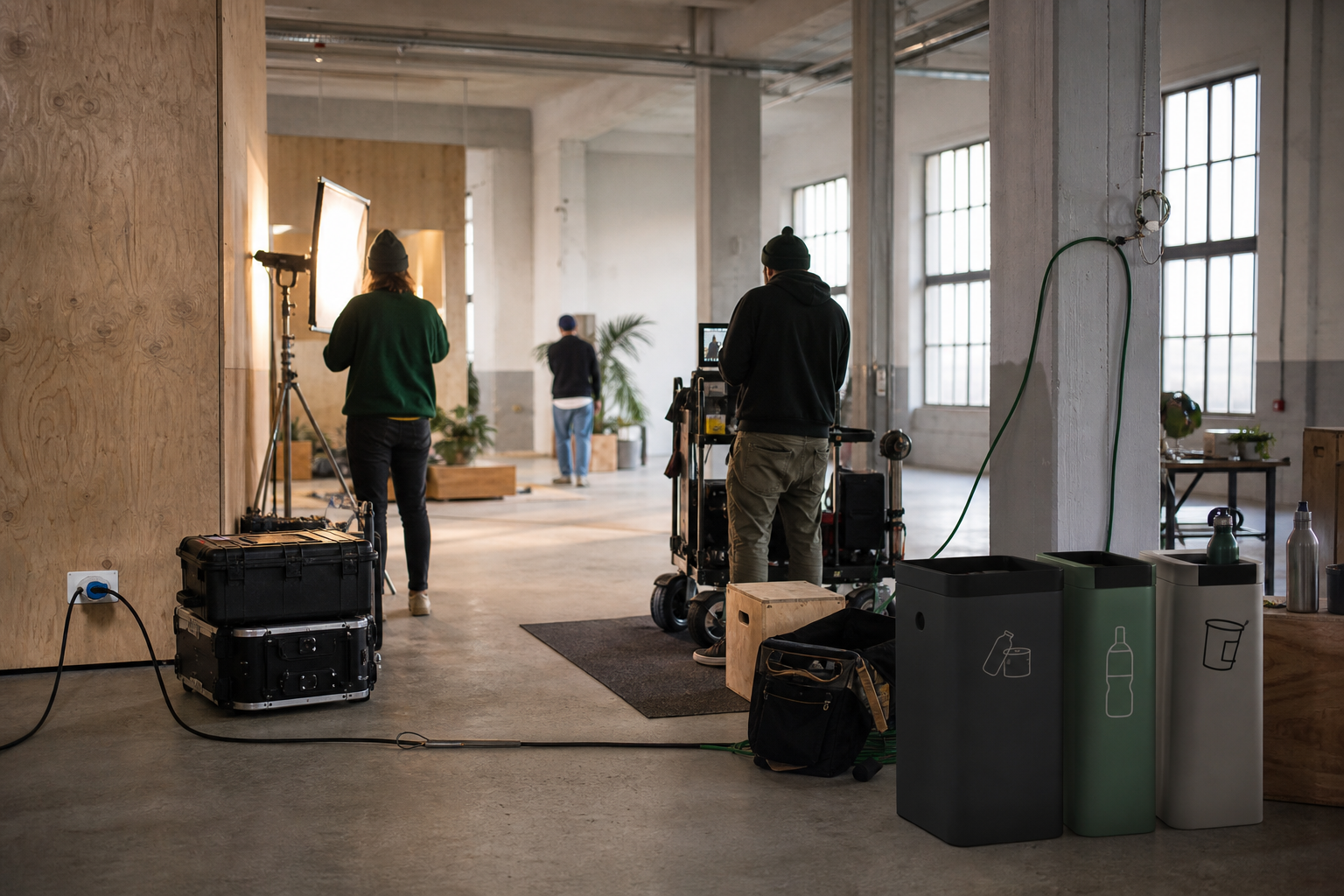
Green Filming an einer produktionsbereiten Location by OpenAI image generation for SetScout Original image generated for SetScout; no third-party source image used
A practical Green Filming checklist for locations: assess grid power, travel, hotels, catering, waste separation, and reliable evidence before booking.
Green Filming does not begin with the carbon report. The choice of location determines power supply, travel, overnight stays, catering, material transport, and waste separation at an early stage. Checking these points in the location brief and during the recce helps prevent costly modifications and creates more reliable documentation of what is actually possible on set.
Green Filming is the practical umbrella term for film production that aims to use fewer resources and have a lower climate impact. Germany has nationally coordinated ecological standards for cinema, television, online, and VoD productions. The current version has applied since 1 November 2025 and contains 25 mandatory requirements. At least 19 must be met to qualify for the green motion label.
These requirements do not automatically apply to every commercial shoot, music video, or independent photography project. The decisive factors are the funding agreement, client, broadcaster, VoD service, and the production’s voluntary goals. Always check the current version and the terms of your specific project. This article is a planning aid, not funding or legal advice.
A visually perfect location can be environmentally and operationally costly if a generator has to run every day, the crew travels long distances, or catering and waste disposal require additional journeys. A slightly less spectacular location may reduce the overall effort considerably if it already offers grid power, short routes, crew areas, and good logistics.
The September 2025 ecological standards explicitly identify accessible locations, nearby accommodation, pooled transport, and local or small crews as ways to reduce mobility. On-location productions should use grid power wherever a technically suitable connection is accessible. This is precisely why infrastructure belongs in the creative shortlist.
Ask about connector types, circuit protection, freely available load, meter access, cable lengths, and the distribution point. A photo of the fuse box is no substitute for a professional assessment, but it helps with preparation. The standard generally calls for grid power. Generators are provided for only under defined conditions.
The SetScout guide Power at film locations: household power, CEE, generators, and load plans also helps with technical preparation. Final system design belongs in the hands of qualified electricians and the responsible lighting department.
Do not record only the distance from the production office. Check railway stations, public transport, safe cycle routes, loading zones, vehicle requirements, carpooling, and hotels within the production area. Under certain conditions, the current standards require at least 50 percent of overnight stays to be booked in hotels with documented environmental measures or in apartments or holiday homes, when such options are available within 15 kilometres.
A location needs enough space for food service, reusable serviceware, water refills, washing-up or return routes, and separation between set operations and catering. A side room may be enough for a small team. For 60 people, access, a wet-weather backup, refrigeration, seating, and collection become real production issues.
The article Catering and kitchens at film locations explains which details an enquiry should contain. Green Filming does not turn these measures into set dressing: reusable serviceware, regional or organic food, and vegetarian or vegan options must work in the actual supply chain.
Clarify which waste streams the regional disposal provider accepts, where containers may stand, and who empties them after the shoot. The standards require waste separation at every production site, including on location. For the art department and props, it also matters whether existing spaces can be used, materials reused, and installations removed without leaving traces.
Create a short evidence list for each location: contacts, power source, technical assessment, transport plan, accommodation options, catering solution, waste route, approved areas, and deviations. Not every statement from a host is formal evidence. Mark what is confirmed, verified, merely requested, or still open.
A good Green Filming recce connects the creative location with operational data. Include these questions in the report:
SetScout can help productions compare film locations by look and practical conditions and submit complete enquiries. The production team must assess case by case whether a location meets the requirements of its funder, broadcaster, or Green Consultant. A location must not be marketed as “green” or certified without verification.
First build a shortlist of suitable locations, then add the Green Filming assessment questions. On SetScout, you can compare film locations in Germany and include infrastructure requirements in your enquiry from the outset.
No. The specific obligation depends, among other things, on the funding body, client, and production contract. Many teams adopt individual measures voluntarily. The current project terms and the latest version of the applicable standards are always decisive.
No. Power is only one area of action. Transport, accommodation, catering, material use, waste separation, carbon accounting, and evidence also matter. For electricity, the connection, capacity, and actual supply must also be documented reliably.
The label applies to a verified production, not to an individual location as a whole. Hosts can, however, provide data and evidence that help the production with planning and documentation.
No later than the location brief. Teams that assess power, travel, hotels, and crew areas only after signing the contract lose their most important choices.
Article status: 13 July 2026. Sources include the current ecological standards, Green Filming information from MOIN Film Fund Hamburg Schleswig-Holstein, and the primary sources linked throughout. Because standards are revised, check the current version before production begins.
More posts you might be interested in

none by Jakub Zerdzicki All photos and videos on Pexels can be downloaded and used for free.
How to report profits from renting out your location correctly for German tax purposes
Inventorying film equipment before a location shoot
A practical checklist for cameras, lighting, sound and rented film equipment: confirm inventory, values, transport, storage and claims procedures before the shoot.

Film insurance for a production at a prepared location by OpenAI image generation for SetScout Original image generated for SetScout; no third-party source image used
Which insurance modules a film production should review, which details affect the premium and how to include locations properly in the risk assessment.
SetScout is funded through the EXIST program by the Federal Ministry for Economic Affairs and Energy and the European Social Fund Plus (ESF Plus).