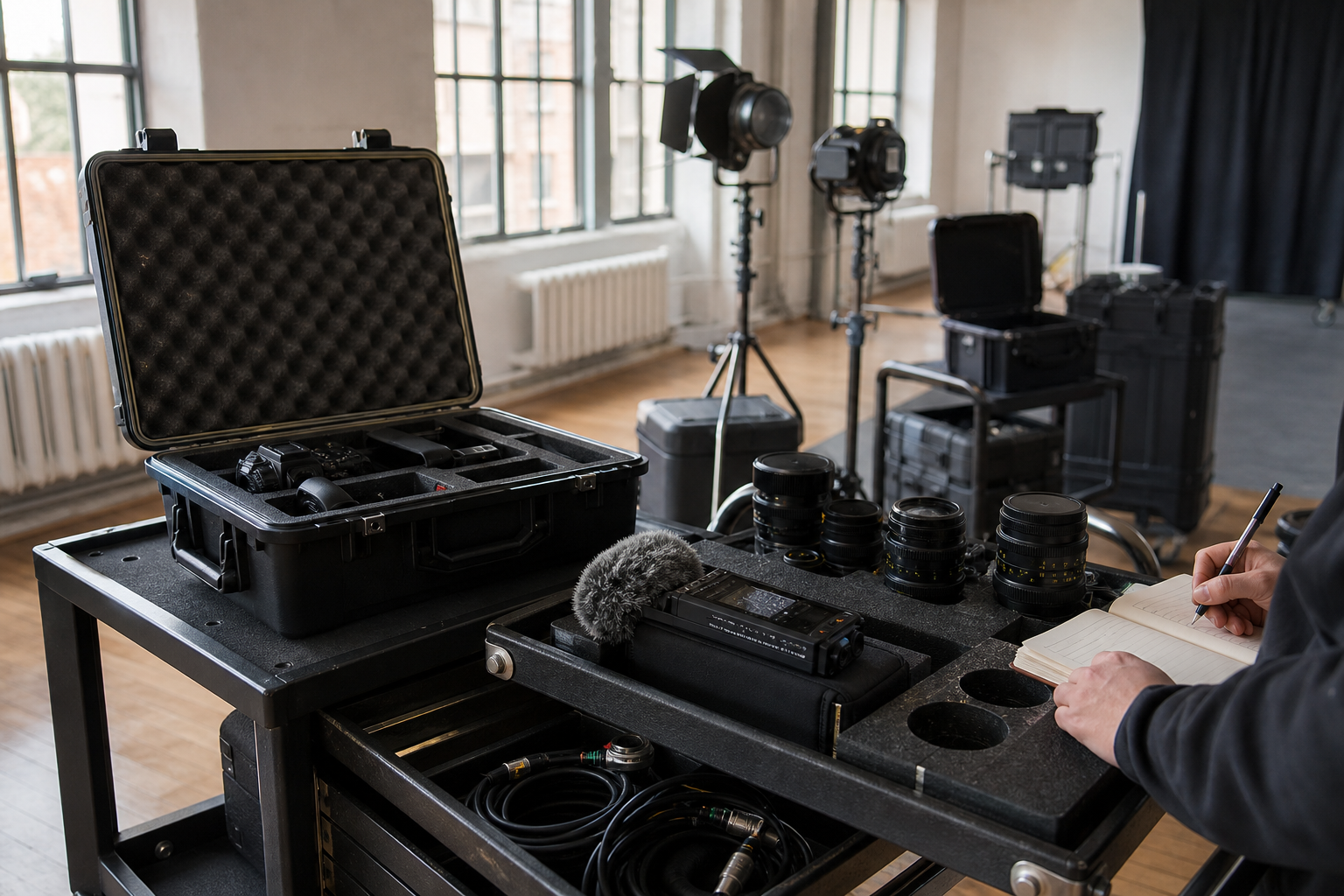
Inventorying film equipment before a location shoot by OpenAI image generation for SetScout Original image generated for SetScout; no third-party source image used
A practical checklist for cameras, lighting, sound and rented film equipment: confirm inventory, values, transport, storage and claims procedures before the shoot.
Film equipment insurance starts not with the policy, but with a reliable equipment list. Cameras, lenses, lighting, sound, wireless systems, monitors, DIT hardware and accessories may belong to different owners, carry different values and travel to the location by several routes. Without separating them, it remains unclear what needs to be checked, for which period and at which place.
This article provides general guidance and is not individual insurance or legal advice. Whether a loss is covered depends solely on the specific contract, including exclusions, deductibles, sublimits and policyholder obligations. Owned and rented equipment should be discussed with a qualified insurance provider or specialist broker before the shoot.
Depending on the provider, the relevant component may be called film equipment insurance, electronics insurance, camera insurance or equipment cover. The product name alone does not tell you which perils and items are included. The BarmeniaGothaer film insurance overview lists film equipment as one of several possible components. This is a useful example of how coverage can be structured, but it does not indicate suitability for a particular project.
The same provider's general 2022 film insurance terms and conditions also show that the insured location, insurance period, perils, indemnity limits and obligations are governed by the contract. Other policies may be structured differently.
For owned equipment, the production needs a current basis of value. Purchase price, actual cash value and replacement cost are not the same. The policy must state which figure determines compensation. Serial numbers, purchase receipts and condition photos make items easier to identify.
With rented equipment, the rental agreement, handover record and insurance requirements all come together. The production should check who is liable for theft, breakage, operator error, missing accessories or late return. Any certificate of insurance required by the rental house should be requested in good time and reviewed to confirm its stated scope.
Crew members' personal equipment and technical systems at the location must not be treated as production equipment by default. The owner, permission to use it, its condition and liability arrangements should be documented in writing. This applies, for example, to installed lighting systems, stage rigging, tools or presentation equipment.
A practical list includes at least the following for each item:
A single line such as “camera equipment, EUR 80,000” may save time, but it makes identification, evidence and claim assessment more difficult. A structured list that can also be used for check-in and check-out at the location is better.
Many losses occur away from the actual filming: during loading, in transit, during breaks or overnight. The production should therefore discuss specific scenarios with the insurer.
These questions need project-specific answers. General theft-prevention advice is no substitute for confirmation of insurance and must never encourage unsafe storage.
A location recce should also map the safe movement of equipment: vehicle access, loading route, stairs, lifts, rain protection, lockable rooms, power distribution and escape routes. The team records where cases may be placed and who manages keys or access codes.
Equipment cover does not automatically protect the location. If a tripod damages the floor or a light damages someone else's property, a different type of cover may apply. Our overview of film insurance treats equipment, production liability and production interruption as separate areas to review.
The location agreement should set out use, protective measures, handover, liability and damage reporting in a clear and traceable way. The insurance terms and the agreement must align; neither replaces the other.
The Film AFV 2022 gives examples of obligations such as reporting a loss without delay, mitigating the loss, retaining damaged parts and reporting certain property offences to the police. The team must record before the shoot which steps and deadlines apply to its own policy.
If you are still looking for a suitable location, you can search SetScout film locations and include technical requirements in your enquiry early on. The more specific the planned use, the easier it is to coordinate the location and equipment workflow.
No. A production should never assume that it is. The policy must include third-party or rented property for the specific period and scope, and the evidence must meet the rental house's requirements.
That depends on the contract. Purchase price, actual cash value, value as new and replacement cost can produce different results. The insurer should explain the applicable basis of value in writing.
Not necessarily. Physical storage media, data recovery and the cost of a reshoot may fall under different coverage components and limits. Media and backup processes must therefore be reliable independently of the insurance.
The policy's specific security requirements and exclusions are decisive. If the terms do not permit storage in a vehicle or cover it only subject to conditions, the production needs secure alternative storage.
More posts you might be interested in

none by Jakub Zerdzicki All photos and videos on Pexels can be downloaded and used for free.
How to report profits from renting out your location correctly for German tax purposes

Film insurance for a production at a prepared location
Which insurance modules a film production should review, which details affect the premium and how to include locations properly in the risk assessment.
Planned production stoppage at a film location by OpenAI image generation for SetScout Original image generated for SetScout; no third-party source image used
How productions can systematically assess key-person and property interruptions, location dependencies, exclusions, and additional costs before filming begins.
SetScout is funded through the EXIST program by the Federal Ministry for Economic Affairs and Energy and the European Social Fund Plus (ESF Plus).