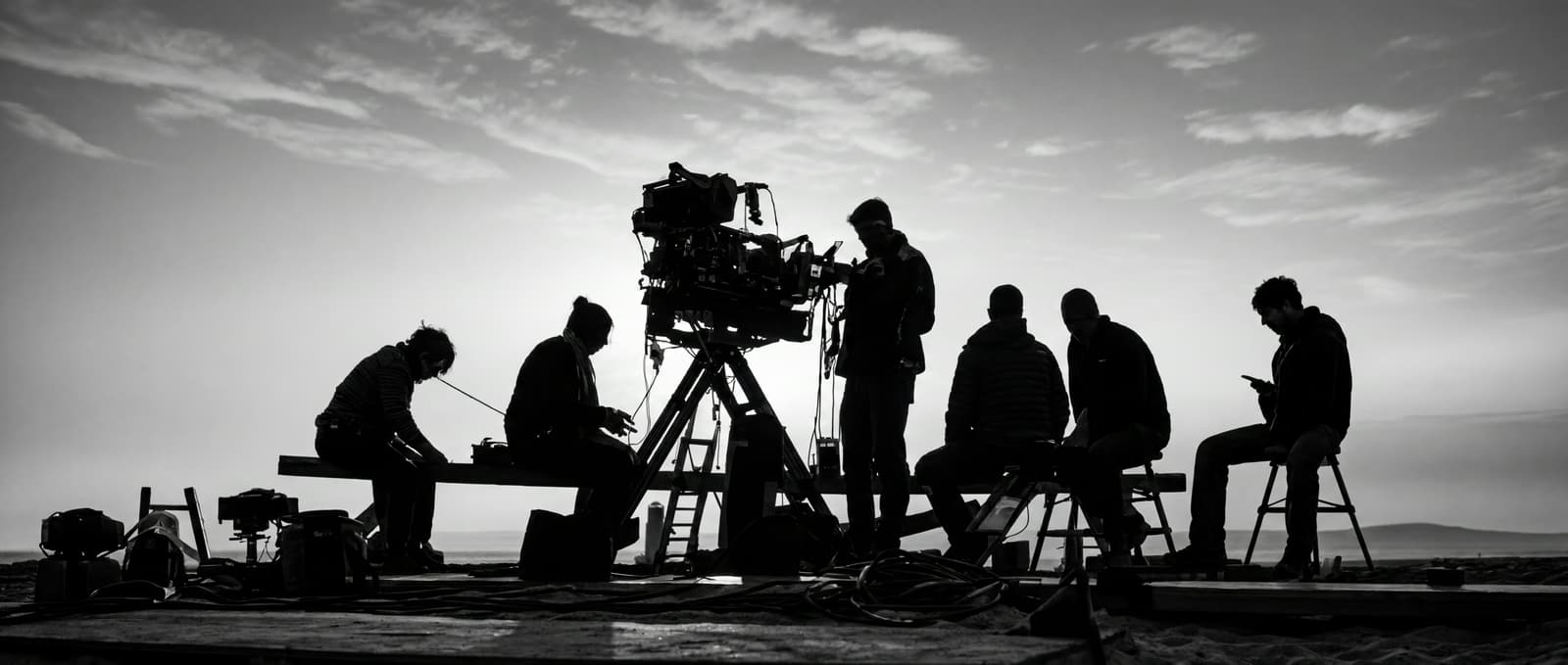
Camera crew on location by Kriss Films / Unsplash Unsplash License
A good location recce checks more than the look. It covers lighting, sound, set dressing, safety, host rules, logistics, and backup decisions.
A location recce is not a group stroll around a beautiful place. It is the point when directing, camera, sound, art department, and production assess whether the location can support the shoot day.
Without the right questions, the recce becomes little more than visual approval, and the problems emerge later in the call sheet: windows cannot be blacked out, refrigerators hum, the art department is not allowed to hang anything, the van has to park three streets away, or an escape route is blocked.
This checklist separates the questions by department. That way, every department leaves the recce with its own decisions, not just phone photos.
A location can be visually perfect and still fail on the shoot day. The recce connects creative intent with technical, logistical, and legal reality. The decision is reliable only once every department has identified its risks.
For film production, BG ETEM explicitly covers topics such as risk assessments, safety briefings, first aid, hazardous substances, and set-specific assessments. These are not peripheral paperwork. They are part of deciding whether a location can be planned safely.
Do not send only the address and time. Everyone involved needs the scene, scripted time of day, planned sightlines, crew size, equipment scale, usable areas, and unresolved dealbreakers.
The director is assessing more than beauty. The space must be playable: it must support relationships, movement, sightlines, and the scene's emotional function.
Camera assesses space, light, and freedom of movement. The key question is not whether a photograph looks good, but whether the planned shots can be repeated within the actual shooting schedule.
Sound needs quiet at the right time of day. A location may seem quiet during the recce but become unusable on the shoot day because of refrigeration, neighbours, traffic, a school, construction work, or hospitality venues.
The art department needs clear boundaries. The location can only be used creatively if surfaces, furniture, pictures, plants, logos, private belongings, and reinstatement have been discussed in advance.
Production translates every idea into time, movement, and responsibilities. A location is production-ready only when access, parking, holding areas, toilets, power, entry, neighbours, and host communication have been clarified.
A location recce does not replace a risk assessment, but it provides the observations needed for one. CalArts recommends visiting locations with key participants before filming and reviewing safety, access, scheduling, and shooting strategy.
A good host can resolve many problems early if the questions are specific. Do not ask only whether filming is possible. Ask which rules will constrain the shoot.
Do not summarise the recce as a photo album. Decide with a concise traffic-light system: creatively suitable, technically feasible, acceptable for sound, approved by the art department, realistic for production, safe to plan, and contractually resolvable.
If a category is red, it needs a solution before booking. If it is amber, it belongs in the call sheet, contract, or technical plan. The location is only truly confirmed once every open point has an owner, deadline, and cost.
SetScout can speed up the location search and shortlisting process, but the recce remains the reality check. Use search to preselect suitable locations, and bring these department-specific questions before making a final enquiry or confirming the location.
The more specific your recce findings are, the stronger the contract, price, call sheet, and host communication will be.
At minimum, someone from directing, camera, production, and location management. If the shoot involves recorded dialogue, alterations, stunts, substantial equipment, or sensitive areas, sound, art department, lighting, and safety should also attend or receive a focused briefing.
For simple interiors, 30 to 60 minutes is often enough. Complex locations with multiple areas, exteriors, technical access, neighbours, or safety questions need longer and should not be squeezed between two appointments.
Not quite. A location recce can establish early on whether the location is broadly suitable. A tech recce usually takes place closer to the shoot and resolves technical details with the responsible department heads, the actual equipment, and the planned schedule.
Document photographs, floor-plan sketches, parking, power points, noise, restricted areas, contacts, outstanding approvals, risks, protective measures, and every cost or scheduling consequence. A decision without these points is not a genuine confirmation.
More posts you might be interested in

none by Jakub Zerdzicki All photos and videos on Pexels can be downloaded and used for free.
How to report profits from renting out your location correctly for German tax purposes
Inventorying film equipment before a location shoot
A practical checklist for cameras, lighting, sound and rented film equipment: confirm inventory, values, transport, storage and claims procedures before the shoot.
Film insurance for a production at a prepared location by OpenAI image generation for SetScout Original image generated for SetScout; no third-party source image used
Which insurance modules a film production should review, which details affect the premium and how to include locations properly in the risk assessment.
SetScout is funded through the EXIST program by the Federal Ministry for Economic Affairs and Energy and the European Social Fund Plus (ESF Plus).